2026: The Year Webtoons Go Live-Action - Disney+ and Netflix Battle Over K-drama
2026 is the year hit webtoons arrive as live-action series like 'The Remarried Empress,' 'Delusion,' 'Solo Leveling,' and 'Bloodhounds 2,' fueling a new streaming battle. Here's why webtoon IP is now driving K-drama.
2026 is shaping up to be the year K-dramas based on Korean webtoons truly take over. Disney+ and Netflix are both rolling out high-profile adaptations, drawing intense attention from viewers around the world. Years of webtoon fandom, combined with increasingly fierce competition among streaming platforms, have turned this into one of the most talked-about trends in Korean entertainment.
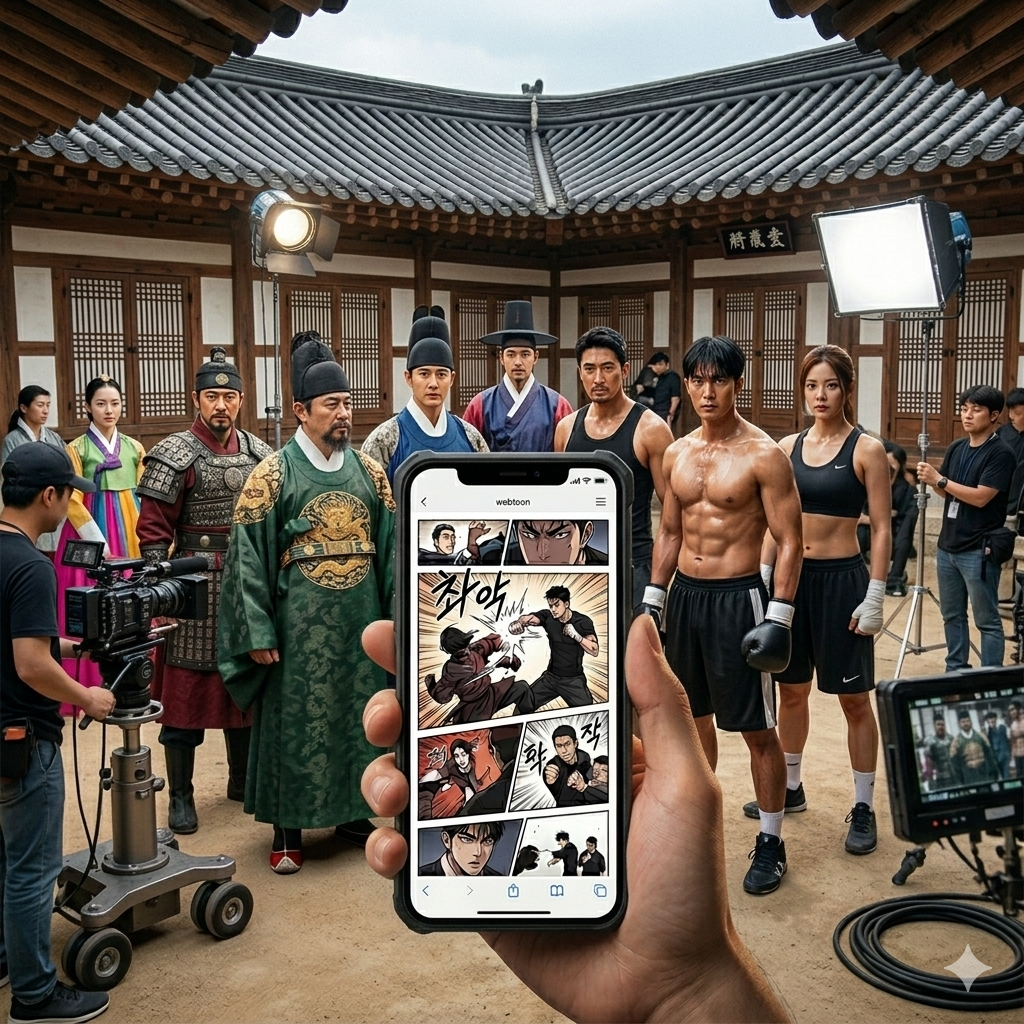
A webtoon is a vertically scrolling digital comic designed for smartphones, typically released in short serialized episodes that are easy to read on the go. Since the 2010s, the format has exploded in popularity, and past hits like Itaewon Class and Sweet Home proved that webtoons could work just as well on screen as they do on a phone. With strong story structure and memorable characters already built in, webtoons have become one of the industry’s most reliable sources for screen adaptation.
One of the biggest titles at the center of this wave is Disney+’s The Remarried Empress. Based on a romance-fantasy webtoon with more than 2.6 billion views, it follows Empress Navier, who is asked for a divorce after Emperor Sovieshu falls for another woman, and responds by declaring she will remarry into a rival empire instead. With a cast led by Shin Min-a, Ju Ji-hoon, Lee Jong-suk, and Lee Se-young, plus location shooting in Europe, the series promises a mix of Korean drama sensibility and Western court fantasy spectacle.
Another major title to watch is Delusion, also known internationally as Portraits of Delusion, a mystery thriller set in 1935 Gyeongseong. Suzy stars as Song Jeong-hwa, the owner of Nammoon Hotel, who has not been seen in public for decades, while Kim Seon-ho plays the painter Yun I-ho, who is commissioned to create her portrait. Directed by Han Jae-rim, the series immediately drew attention when its first stills were released, largely because Suzy looked strikingly close to the original webtoon character, and it is currently slated for the second half of 2026.
Solo Leveling began as a web novel and then grew into a webtoon and anime phenomenon, amassing more than 14.3 billion views worldwide. Netflix is now developing it as a live-action series with Kakao Entertainment and Sanai Pictures, with Byeon Woo-seok cast as lead character Sung Jin-woo. The exact release date has not been announced yet, but the project is already generating serious buzz thanks to its huge existing fanbase and the promise of a world-class VFX team bringing its dungeons and battles to life.
The second season of Bloodhounds is another key release that will keep the webtoon adaptation boom going in 2026. The first season, adapted from a Naver Webtoon, became a hit in 83 countries with its story of two young boxers fighting back against predatory moneylenders. Season 2 expands the scale dramatically, bringing in Rain as the new villain Baek-jeong and moving the action into an international underground boxing league, with its Netflix release set for April 3.
And these are only the most visible examples. The 2026 slate also includes a wide range of other webtoon-based projects, from Perfect Crown, starring IU and Byeon Woo-seok, to Yumi’s Cells Season 3, along with titles like Teach You a Lesson and Mousetrap. Romance, action, thriller, and comedy are all represented, which makes it clear that webtoons are no longer just feeding one corner of Korean TV but helping shape the entire field.
This wave is more than a temporary trend. For Disney+ and Netflix, webtoon IP offers something incredibly valuable: a built-in audience and stories that have already been tested by millions of readers. When webtoons, anime, live-action series, and merchandise start feeding into one another, they create a cross-media ecosystem that allows Korean content to travel farther and faster than ever before.
That said, not every adaptation is guaranteed to work. Fans of the original material can be harsh when characters, settings, or tone are altered too much, and rumors about casting and release schedules often run ahead of confirmed information. The challenge for producers is figuring out how to preserve what readers loved while also making the story work in a live-action format.
What is happening in 2026 says a great deal about where Korean culture is headed. Stories that once lived on smartphone screens are now becoming lavish productions led by major stars and global platforms, opening them up to audiences far beyond Korea. For K-content fans and industry watchers alike, this is not just another wave of adaptations but a revealing look at how digital storytelling, fandom, and streaming are being fused into the next phase of Korean entertainment.