BTS' 'Arirang' World Tour: A Global Craze Fueled by Their First Full Return in Four Years
BTS launched their 'Arirang' world tour in Goyang in April 2026, selling out more than 80 shows across 34 cities. With its 360-degree stage and fans flying in from around the world, the tour is once again proving K-pop's global pull and its impact on tourism.
On April 9, Goyang Stadium in Gyeonggi Province turned into a sea of purple, even in the rain. As BTS opened their new world tour, fans from around the globe lined up from early morning and filled every seat in the venue. Both the crowd and the members were drenched by the downpour, but the atmosphere only grew more electric. Even outside the venue, hundreds of thousands tuned in through a livestream focused on the stadium grounds.
The “Arirang” World Tour marks BTS’ first global concert run as a full group in four years, built around their fifth studio album, ARIRANG. It is their first tour since regrouping after completing military service, and global attention has surged as the new album climbed the Billboard charts after its March 2026 release. By using the title “Arirang,” the group also ties the project to one of Korea’s most iconic traditional songs, giving the comeback a broader cultural resonance.
This is the largest K-pop concert tour ever mounted, stretching across Asia, North America, Europe, and Latin America with more than 80 performances in 34 cities. After launching in Goyang, the tour moves through cities such as Tokyo, Tampa, Mexico City, and London, all in major stadium venues. One of its biggest technical signatures is the 360-degree rotating stage placed at the center of the arena, designed so that fans in every section can feel close to the performance.
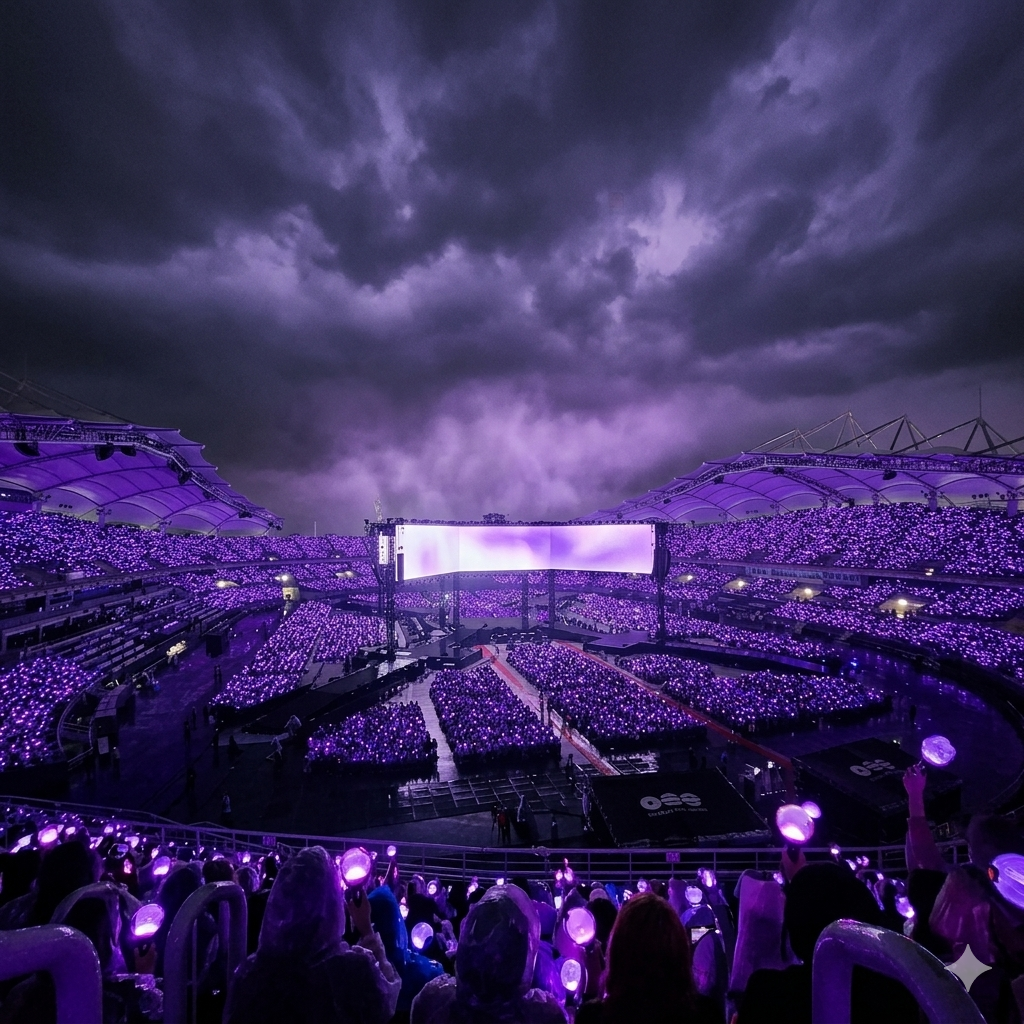
(This image was generated with AI and may differ from reality.)
At the opening show, fans in matching purple ponchos waved their light sticks and embraced the rain together, whether they had come from Korea or overseas. Some had flown in from Australia, while others had traveled hundreds of kilometers within Korea just to be there. The audience sang along in unison and responded to each member with different chants, turning the entire 23-song set into a shared event rather than a one-way performance.
Ticket demand was explosive from the moment sales opened. The Goyang dates sold out during presale, and tickets for South Korea, North America, and Europe disappeared within hours of general release. Industry analysts believe the tour could generate revenue in the trillions of won from ticket sales alone. That level of demand has already led to additional dates, live-viewing screenings, and a broader push to accommodate fans in multiple countries.
The excitement has been just as intense online. Around 500,000 people joined a three-hour livestream showing the area outside the venue, while clips and reactions from the concert spread across social platforms in real time. On Reddit, discussion around the tour grew so quickly that fans created a third megathread just to keep pace with updates. In Mexico City, where BTS now has an especially concentrated fan base, the tour has further fueled enthusiasm across Latin America.
Musically, the concerts balance new material with longtime fan favorites. Songs from ARIRANG, including the title track “Swim,” have been placed alongside older hits in a set list designed to feel both nostalgic and forward-looking. BTS also worked Korean visual and thematic elements into the staging and performance design, giving international audiences a concert experience that feels unmistakably tied to Korean culture.
The title “Arirang” can be confusing for foreign readers, since it may first bring to mind the Korean folk song or even Arirang TV. Here, however, it refers to BTS’ album and tour title. The production is also distinct from previous BTS tours such as Map of the Soul or Love Yourself, especially in the way the 360-degree stage reshapes sightlines and audience movement. That difference gives this tour a noticeably different visual language from the group’s earlier stadium shows.
Ultimately, BTS’ “Arirang” World Tour is more than a concert series. It is a clear sign of how K-pop now moves culture, money, travel, and online attention across borders at once. Sold-out dates, international fan travel, and nonstop digital sharing are all feeding new interest in Korea as both a cultural and tourism destination. The tour captures how K-pop continues to evolve on the world stage, and it is likely to shape conversations about live entertainment and fan-driven travel well beyond 2026.
Sources