Why BTS's comeback concert brought Gwanghwamun to a halt
BTS's free comeback concert at Gwanghwamun Square in March 2026 was a massive K-pop event that combined a public urban plaza, citywide safety controls, and a global Netflix livestream.
On the night of March 21, 2026, Gwanghwamun Square in the middle of Seoul briefly seemed to stop moving. BTS was holding a free concert there to mark the release of its comeback album “ARIRANG.” The square was packed with fans before and after the show, and the level of attention was so intense that traffic in central Seoul had to be controlled. It became one of those rare public events where a single performance could shift the rhythm of an entire city.
The concert began at 8 p.m. under the title “BTS THE COMEBACK LIVE | ARIRANG,” and the venue was Gwanghwamun Square, not far from Seoul City Hall. Organizer BIGHIT MUSIC announced the schedule and ticketing details through Weverse, and even though the concert was free, the number of seats was capped at 13,000. Interest was so intense that every seat disappeared as soon as reservations opened, and fans who could not get tickets gathered around the square and nearby areas where large screens were installed.
The performance also carried unusual weight because it was BTS’s first major full-group stage after all members had completed their military service. After a long stretch in which the group had focused on individual activities, BTS used this night to unveil new music to Korean fans and formally signal its return. Fans who had waited for that moment for years filled the square with light sticks, turning the entire area purple.
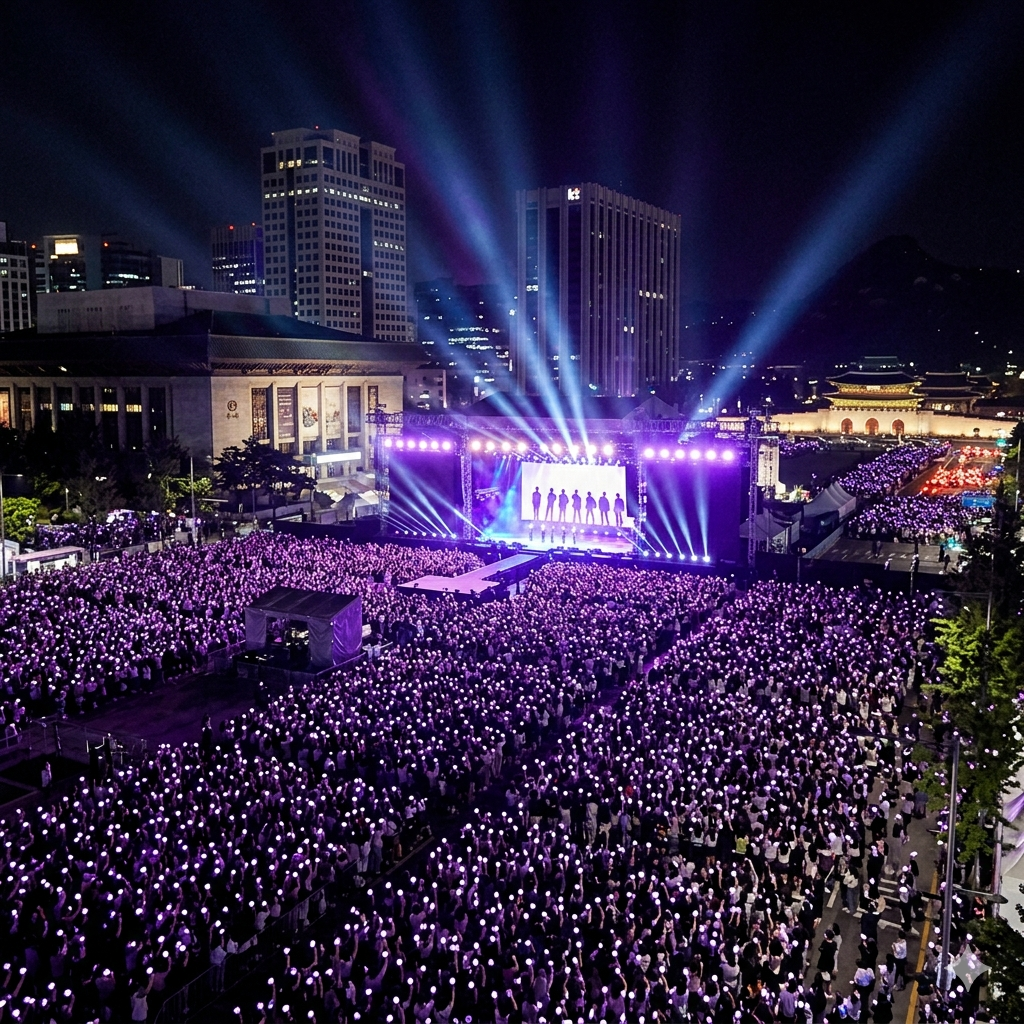
The choice of Gwanghwamun Square became a story in itself. Since its reopening, the square has served as a symbolic civic space where protests, commemorations, and cultural programs all coexist, and this was the first time a K-pop concert had been staged there outside of major national ceremonies. Because it unfolded in the center of the city, it also drew attention as a bold example of how public space could be used more freely. With roads and office buildings forming part of the backdrop, the concert hinted at what a large-scale cultural event in downtown Seoul could look like.
Even though the concert was free, the divide between those who secured seats and those who did not was clear. Roughly 13,000 ticket holders watched from designated seating near the stage, while tens of thousands of other fans remained on surrounding streets and around the square to experience the event from outside. That contrast only heightened the atmosphere on site. The tension between a public event open in principle and a tightly limited seating system spread quickly across social media.
As officials anticipated a massive turnout, the Seoul Metropolitan Government activated full-scale traffic and safety measures. Gwanghwamun Station and nearby subway stations temporarily skipped stops during concert hours, and vehicle traffic around Sejong-daero was partially restricted. Around 6,500 police officers and safety personnel were deployed, and entry gates and metal detectors were installed to maintain order. The scale of the response showed what kind of public management is required when a globally known group stages a major outdoor concert in the middle of a city.
The concert did not belong only to the people physically in Seoul. It was livestreamed to more than 190 countries through Netflix, and according to official figures, more than 18.4 million people watched simultaneously around the world. That hybrid format, combining a live audience with a global digital one, expanded the scale of the event far beyond the square itself. For one night, Gwanghwamun was not just a plaza in Seoul but a stage visible across the world.
There are also a few points that can easily confuse overseas readers. The phrase “free concert” may sound like anyone could simply walk in, but in reality, reserved seats were required, and non-ticketed viewers followed the performance from outside through large screens. Another point is the crowd estimate: police prepared for as many as 260,000 people, but that number was a safety planning ceiling, not a confirmed attendance figure. It is more accurate to describe the audience as a massive crowd than to treat any single number as final.
What happened here was not just a concert but a new K-pop model shaped by public space, global streaming platforms, and the entertainment industry working together. A free performance in the center of the city, supported by coordinated traffic controls and safety planning, became a powerful way to project Seoul’s cultural capacity to the world. At the same time, the global livestream showed how K-pop can now move beyond geography almost instantly, allowing fans everywhere to participate in the same moment.
This BTS comeback concert will be remembered as more than a stage performance. The members returned from military service and reunited with fans in a public square, Seoul carried out large-scale safety controls around the event, and Netflix delivered the moment as a live K-pop broadcast to global audiences. Taken together, those elements turned the concert into a cultural marker. It also opened up a bigger question worth watching: how Korean cities might continue to connect public space with global entertainment platforms in the years ahead.