Why French Fry Meetups Are Trending in Korea: The Lightest Kind of Social Connection
French fry meetups are Korean micro-gatherings where strangers share fries, showing how Karrot and burger brands turned low-pressure socializing into a trend.
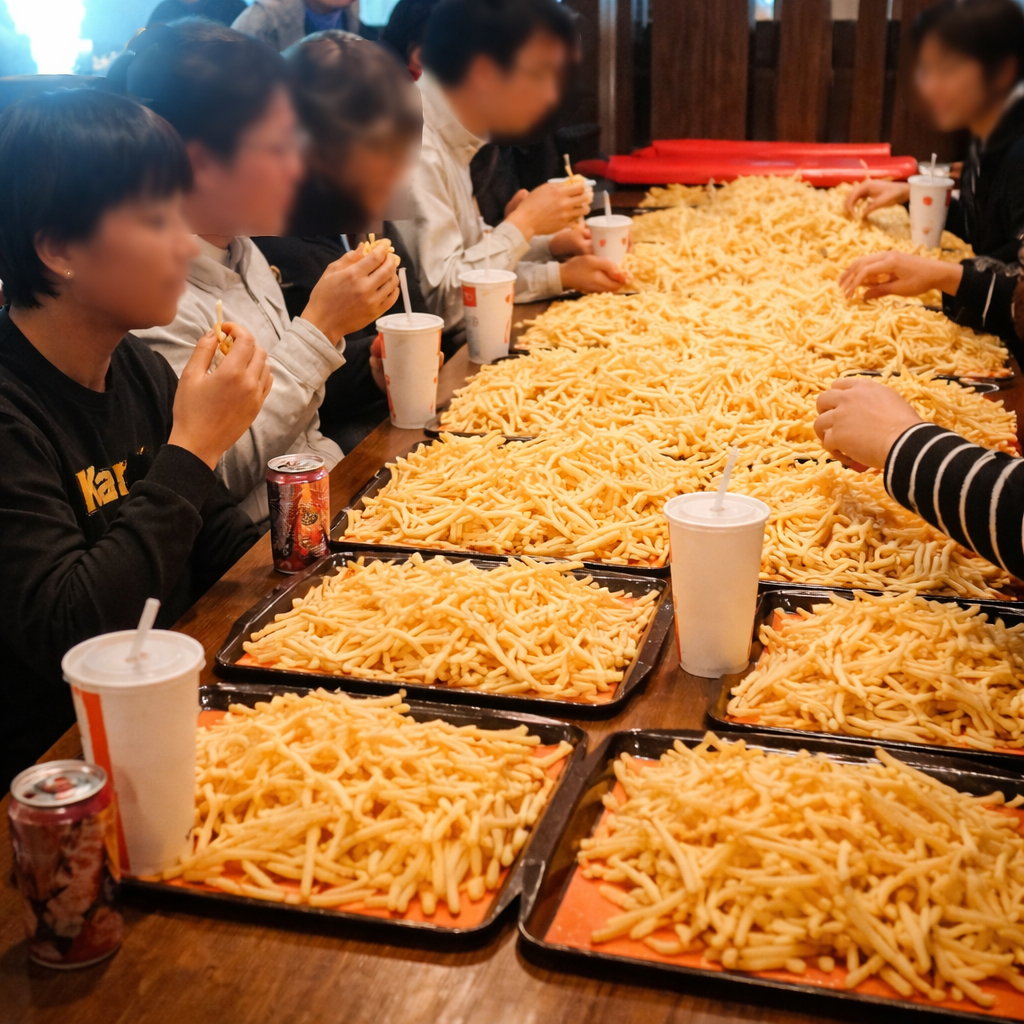
In Korea, “French fry meetups” are becoming one of those trends that sounds like a joke but has turned into a real offline culture. Someone posts a short message on a neighborhood community app, something like “Anyone want to grab fries tonight?”, and strangers show up at a fast-food restaurant, pile fries on the table, eat, chat briefly, and leave. In a time when meeting new people often feels harder than it should, this format is getting attention for the opposite reason: it works precisely because it is so light.
A French fry meetup is exactly what it sounds like. The point is not to have a full burger meal or spend hours together, but to order multiple servings of fries, stack them in the middle of the table, talk for a bit, and then naturally part ways. To overseas readers, it may sound oddly specific, but in Korea, this kind of small-purpose gathering has recently become a recognizable social format.
A big reason the trend has grown so fast is the platform behind it. As of late January, Karrot had 99 meetup groups related to French fries, with 11 of them in Seoul alone. One group in Mapo reportedly attracted more than 700 members within just two weeks of launching, and by February some groups had grown past 1,000 members, with others approaching 1,300. What began as a tiny, spontaneous meetup idea quickly multiplied into neighborhood-based micro-communities inside the app.
Part of the reason it feels so timely is that Korea’s offline meetup culture has been moving toward formats that are shorter, lighter, and require less explanation. In official blog posts and press materials, Karrot has described French fry meetups and “gyeongdo” meetups in the same broader trend, pointing to the rise of neighborhood-based hobbies and looser forms of connection. In that sense, French fry meetups are less a random novelty than an extension of an already emerging culture of low-pressure socializing.
The format works because both the cost and the emotional burden are low. Fries are cheaper than a full burger set, and splitting the bill is easy through Dutch pay or simple app transfers. More importantly, there is very little pressure to become close friends or promise to meet again. Sharing one favorite menu item is enough reason to show up. That turns out to be a surprisingly strong foundation for meeting people.
The way these meetups are run has also evolved to match that low-pressure mood. According to a Newsis report based on direct participation in one event, some groups operate with informal rules such as moving in groups of at least three and discouraging private one-on-one meetings or exchanging personal contact information. Because many participants are meeting for the first time and come from mixed age groups, organizers often post reminders asking everyone to be mindful of boundaries and behavior. The structure is designed less to create instant intimacy than to make short, safe interaction possible.
So why fries, specifically? Fries are cheap, easy to find, and visually simple in a way that instantly creates a scene when they are piled in the center of the table. They also come with endless small preferences that are easy to talk about: whether fries should be crispy or a little soft, whether ketchup is essential, or whether dipping them in ice cream or a shake is the best combination. In that sense, fries function less like a meal and more like a prop that gets conversation started.
This trend is not limited to Seoul, either. Reports say spontaneous fry meetups have appeared not only in areas like Mapo and Daechi-dong in Seoul, but also in Busan, Daegu, Incheon, Siheung and Uijeongbu in Gyeonggi Province, Cheongju in North Chungcheong, and Jeonju in North Jeolla. Because the trend began on a neighborhood-based platform, it was easy to replicate inside ordinary local living areas rather than just in a handful of famous hotspots. That is why the phenomenon makes more sense when you look first at the platform structure rather than at any one trendy district.
What is especially interesting is how quickly brands moved to absorb the trend. Lotteria and McDonald’s both posted welcoming messages about fry meetups on their official social channels, and Lotteria even ran an event allowing people to freely bring different sauces. McDonald’s revived attention around an earlier fry meetup at its Busan National University location and later planned official fry meetup events in partnership with Karrot. A grassroots social fad was almost immediately folded into franchise marketing.
There are a couple of points that overseas readers may easily misunderstand. This is not a traditional Korean food custom. It is a highly contemporary social format created at the intersection of neighborhood apps and fast-food chains. And despite the word “meetup,” it is not really designed like a club or friendship circle that aims for deep bonds. The point is not to complete a relationship, but to briefly share a laugh, a snack, and a moment before moving on.
That is why French fry meetups are more interesting as a story about how people in Korea connect now than as a story about fries themselves. They fit a social rhythm defined by low cost, simple rules, clear tastes, and low responsibility. So the more revealing question may not be “Why fries?” but “Why do such light, low-commitment forms of meeting feel necessary right now?”