A new chapter for Yeouido's 63 Building: Centre Pompidou Hanwha Seoul
Through a partnership between France's Centre Pompidou and the Hanwha Foundation, the annex of Yeouido's 63 Building is being reborn as a modern art museum. Opening in June 2026, Centre Pompidou Hanwha Seoul will launch with a Cubism exhibition and spend the next four years presenting world-class works alongside a distinctly Korean perspective.
The annex of Seoul’s landmark 63 Building in Yeouido is set to reappear before the public on June 4 in an entirely new form. That is when Centre Pompidou Hanwha Seoul, a branch of France’s national museum of modern and contemporary art, will open its doors. Originally expected to launch in 2025, the project was pushed back to 2026 as remodeling plans were adjusted, which only intensified anticipation. Now that the inaugural exhibition and broader program have come into view, the art world in Korea and abroad is watching closely. So why is this aging Yeouido building suddenly being talked about as a new global hub for modern art?
The project formally began in March 2023, when the Hanwha Foundation and Centre Pompidou signed a memorandum of understanding, followed by a full agreement later that year. Under the deal, the two sides secured four years of branding rights and access to works from the Pompidou collection, while committing to jointly plan exhibitions and programs through a shared curatorial framework. The annex of the 63 Building, once home to an aquarium, gained a new symbolic role through the partnership: it would become the first overseas outpost of Centre Pompidou. The original opening target of October 2025 was revised during construction, and the opening is now set for June 2026, with a four-year run that includes two Pompidou collection shows per year alongside independently curated exhibitions.
The redesign of the museum was led by French architect Jean-Michel Wilmotte. Known for his work on the Louvre, the Elysee Palace, and Incheon International Airport, Wilmotte transformed the annex into a sleek contemporary art space with horizontal bands of light across the facade and a double-glass exterior. Inside, the museum is organized around two galleries totaling about 3,300 square meters. Each space was designed with a sense of height and openness so it can accommodate large-scale works and installations.
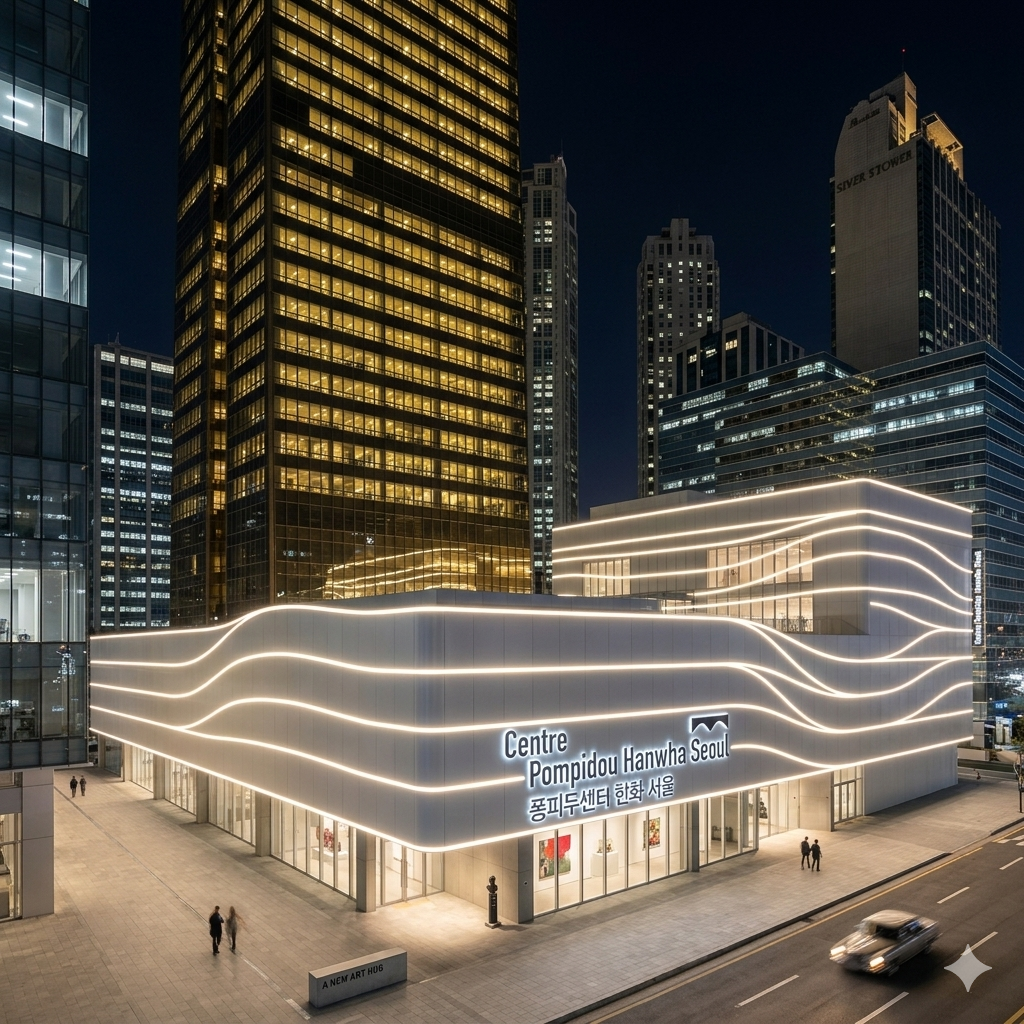
The inaugural exhibition is titled “The Cubists: Inventing Modern Vision.” Jointly organized by French and Korean curators, it will bring together around 90 works by more than 40 artists, including Pablo Picasso, Georges Braque, Fernand Leger, Juan Gris, and Sonia and Robert Delaunay. Structured across eight sections, the show traces the birth and development of Cubism, the movement that reshaped 20th-century art. It also includes numerous works that will be shown in Korea for the first time. One of the highlights is a large stage curtain created by Picasso for the ballet “Mercure,” which will be unveiled in Korea for the first time, offering visitors a rare way to experience Cubism in relation to the performing arts.
The exhibition does not stop at introducing major works from the West. It also includes a Korean section that looks at how Cubism influenced visual art, photography, literature, and dance in Korea. That section explores where Western art history and Korean cultural history intersect, and how Korean artists reinterpreted European movements to create their own visual language. For Korean visitors, it adds local depth. For international audiences, it opens a window into how modern Korean culture absorbed and transformed outside influences.
After the opening, the Hanwha Foundation plans to stage two exhibitions a year built around works from the Pompidou collection over the next four years. At the same time, it will organize two or three independently curated exhibitions annually to reflect current conversations in Korean and global art. Upcoming programs are expected to focus on figures such as Chagall, Kandinsky, and Matisse, as well as movements like Fauvism and the work of Brancusi, a pioneer of abstract sculpture. Exhibitions centered on women artists long pushed to the margins of art history are also in preparation. The broader goal is to create a space where internationally recognized masterpieces and Korean perspectives can coexist in balance.
Research and education will be another major part of the institution. Korean and French curators will collaborate on research and learning programs, and over time the foundation hopes to expand international exchange by creating residency opportunities for promising Korean artists and curators. These initiatives are meant to make the museum more than a place to simply view exhibitions. The aim is to build a space where artists and audiences can grow together. With Centre Pompidou’s extensive archive behind it, the museum also plans to deepen the interpretation and teaching of modern and contemporary art.
The rapid growth of Korea’s art market and cultural tourism in recent years also forms part of the backdrop. Large-scale events like KIAF and Frieze Seoul have brought increasing numbers of collectors and international visitors to the city, while Yeouido itself is shifting from a financial district into a broader cultural zone. Centre Pompidou Hanwha Seoul is expected to build on that momentum and help elevate Seoul into a more prominent Asian hub for modern and contemporary art. For overseas travelers, it could become a new kind of itinerary: seeing landmark works of modern art while taking in the Han River and the city’s skyline.
A few terms may be confusing for international readers. Centre Pompidou Hanwha Seoul is a branch operated through a partnership that uses the Pompidou name and collection; it does not mean the Paris institution is relocating. Depending on the article, the building may be referred to as either the “63 Building” or “63 SQUARE,” but both names refer to the same site. The museum itself occupies the fully renovated annex. Early reports also mentioned a 2025 opening, but the confirmed opening date is now June 4, 2026, which helps clear up some of the confusion.
In the end, Centre Pompidou Hanwha Seoul aims to be more than an exhibition venue. It is being positioned as an open platform where art, technology, and the future can meet. Backed by the prestige of a world-renowned museum, it has the potential to become a cultural bridge between Korea and France, introduce broader currents in modern and contemporary art, and create new opportunities for local artists. As it begins to glow within Yeouido’s skyline, the space may offer travelers to Seoul an art experience they will not easily forget.