Dongseo Trail: The Rise of Korea's First East-to-West Long-Distance Trail
The 849-kilometer Dongseo Trail is Korea's first east-to-west long-distance route, drawing attention as a major forest project and future hiking icon.
Lately, one name has been coming up more and more in conversations about travel and hiking in Korea: the Dongseo Trail. Planned as a long-distance forest route stretching from Anmyeondo in Taean on the country’s west coast to Mangyangjeong in Uljin on the east coast, it is the first trail in Korea designed to cross the peninsula from one side to the other. For a country with a deep hiking culture, that alone makes it a landmark project.
The name is straightforward. “Dong” means east and “seo” means west, so Dongseo Trail literally refers to a path linking the two sides of the country. At roughly 849 kilometers in total, it is being positioned as Korea’s first true cross-country long-distance trail. Once completed, it is expected to offer the kind of multi-week journey more commonly associated with famous overseas pilgrimage and trekking routes. At the same time, it has been divided into 55 sections, most of them around 10 kilometers or so, so walkers will also be able to enjoy it in shorter segments rather than committing to the entire route at once.
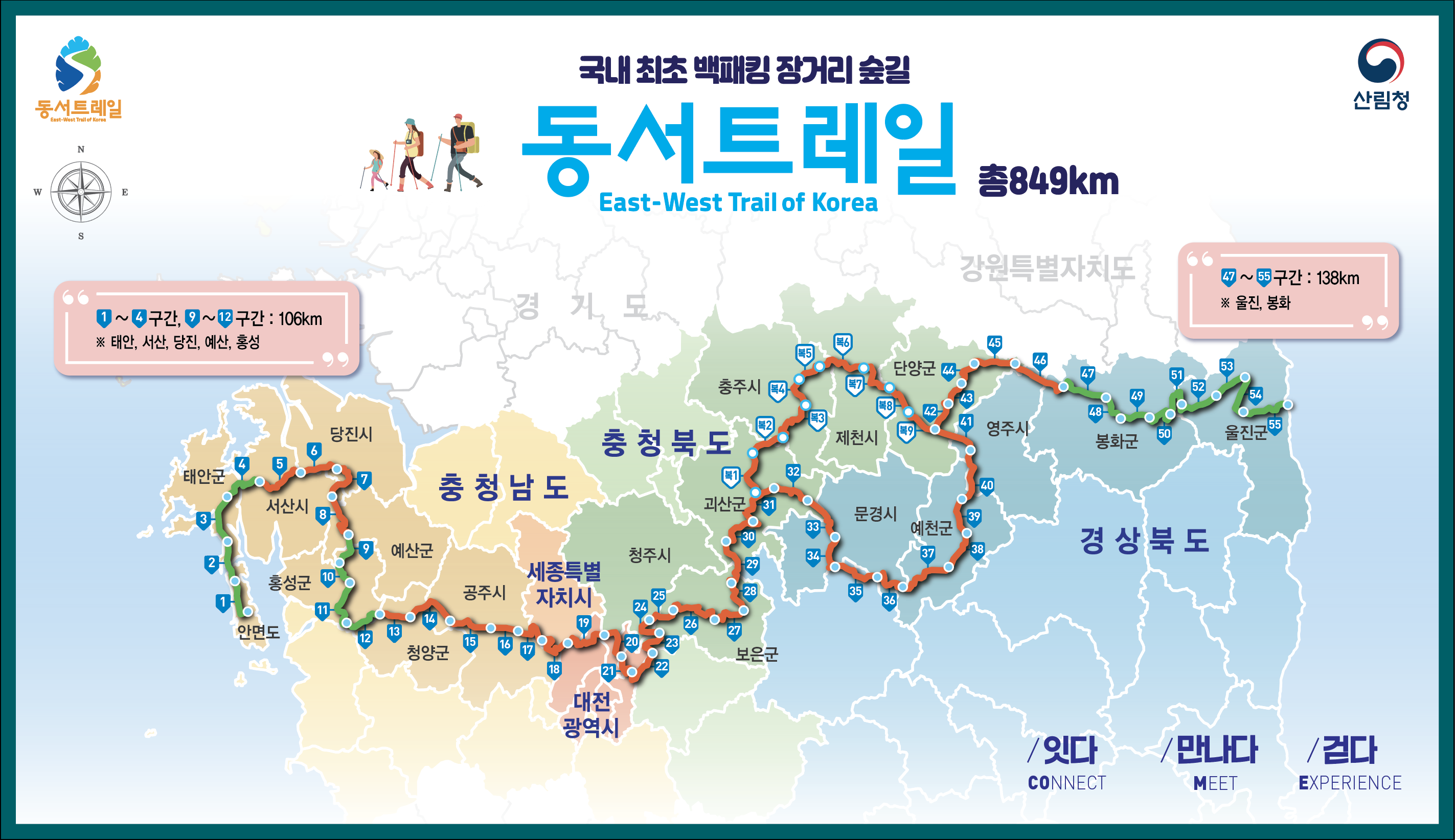
The project has been unfolding in phases since construction began in 2023. In September 2025, the first four sections, covering 57 kilometers, were opened ahead of the full route, with hundreds of hikers joining an opening walk from Anmyeondo Recreational Forest to Kkotji Beach. Earlier that same year, additional sections near the eastern side of the route were also opened on a trial basis, allowing people to get an early taste of the trail before the full network is complete. According to the plan, trial operations for backpackers and specialists are being expanded in 2026, with broader public access expected to follow before the entire route is officially opened in 2027.
What makes the Dongseo Trail especially interesting is that it is being designed as more than just a hiking route. The trail is closely tied to the communities it passes through. Each section is meant to connect with nearby towns and villages, allowing local residents to play a role in welcoming hikers. Plans include stopover villages, simple lodging, meal options, and campsites to support long-distance walkers. That means the experience is not only about forests and mountain paths, but also about passing through temples, old academies, farming communities, and fishing villages along the way. In other words, it is a trail that links landscape with everyday life.
That bigger vision helps explain why the project is attracting attention now. Korea is a country where mountains shape much of the land, and hiking has long been one of the most widely enjoyed outdoor activities. Since the pandemic, interest in slower, nature-oriented travel has grown even stronger. At the same time, there has been increasing policy interest in revitalizing regional areas by drawing more visitors beyond the capital region. The Dongseo Trail sits right at the intersection of those trends. It offers the appeal of a major walking journey while also creating reasons for travelers to spend time in smaller inland communities.
It is worth remembering, though, that the full trail is not yet open. For now, only selected sections are available, mainly in areas such as Anmyeondo and parts of Bonghwa and Uljin. Walking the entire route continuously is still a future prospect tied to the project’s final completion. Some international readers may also assume the trail is close to Seoul, but in fact it runs across Chungcheongnam-do, Sejong, Daejeon, and inland Gyeongsangbuk-do rather than through the Seoul metropolitan area. Spring and autumn are expected to be the most comfortable seasons for walking, and because parts of the reservation and guidance systems are still being refined, checking local updates in advance remains important.
Once fully opened, the trail could be enjoyed in many different ways. Some people may choose a single-day walk on one or two sections, while others may set out on a much longer journey from one coast to the other. The route is also expected to encourage a slower style of travel, with hikers collecting stamps, tasting regional specialties, and spending the night in village-run lodgings or camps along the way. For travelers interested in seeing Korea beyond its major cities, that kind of experience could prove just as meaningful as the scenery itself.
In the end, the Dongseo Trail represents something bigger than a new hiking course. It is a long-term project aimed at connecting Korea’s forests, coasts, villages, and cultural landscapes through one continuous route. As of 2026, only parts of it can be experienced, but the broader vision is already taking shape. For future visitors to Korea, it may become one of the most compelling ways to explore the country at walking pace, from sea to sea.