Why 'Living in Korea for a While' Is Becoming Real Again: The 2026 Workation Visa and a New Way of Searching
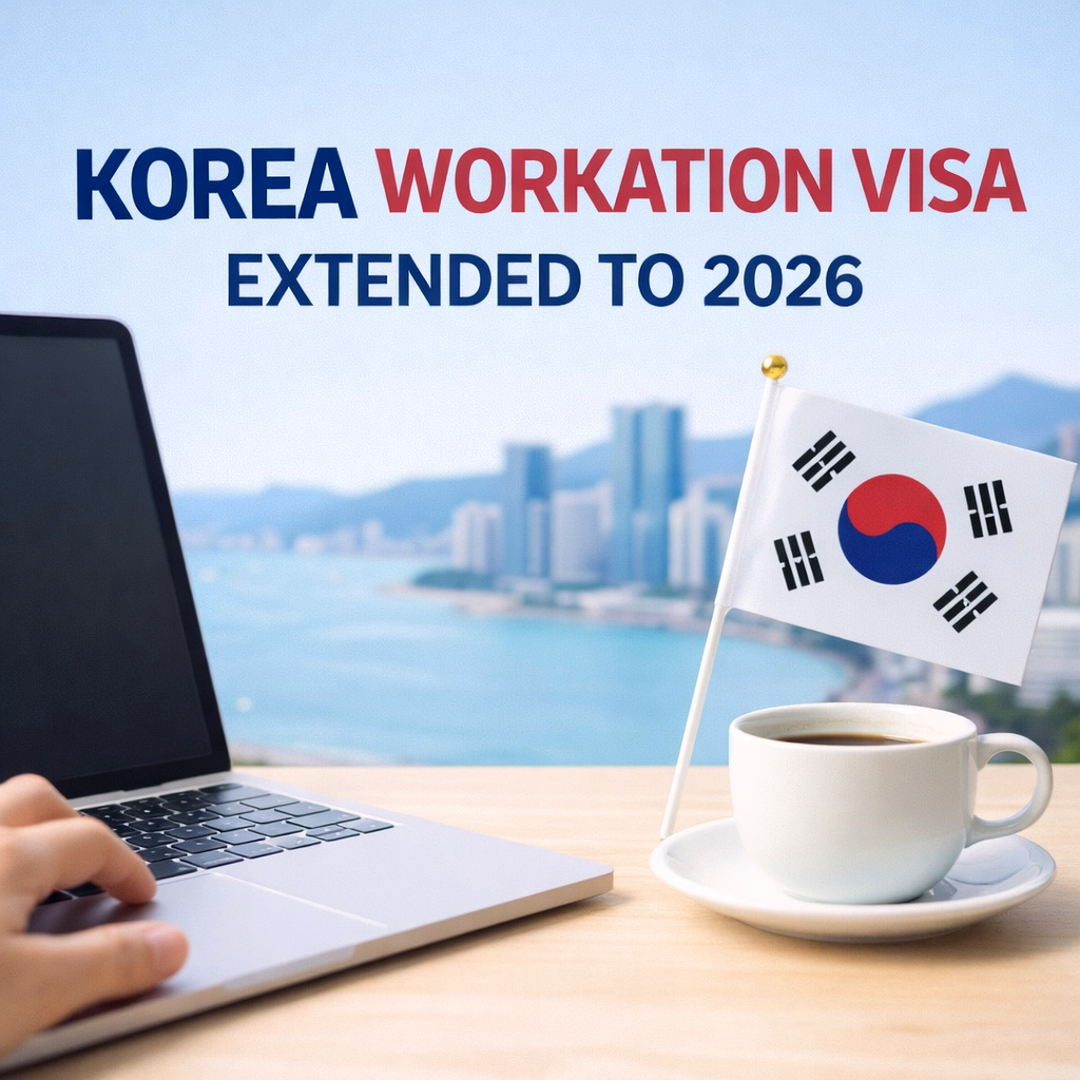
Korea's workation visa pilot has been extended through 2026, pushing more long-stay travelers to compare visa rules and base-city options.
Lately, more foreign visitors talking about Korea are no longer asking for a “three-night, four-day trip.” Instead, they are asking what it would be like to live there for a few months. Interest has grown even more since Korea’s workation visa pilot, created for foreign remote workers, was launched in 2024 and extended through 2026. The idea of staying for a year or more, rather than being limited to the usual 90-day stay allowed under short-term entry, has made Korea feel newly possible for people planning a longer chapter abroad.
The visa in question is Korea’s F-1-D status, a residence category designed for digital nomads. It is meant for people employed by foreign companies or running foreign businesses while working remotely from Korea. To qualify, applicants generally need at least one year of employment or business experience. Even if there is a company in Korea that could technically host the work, the applicant cannot enter into a local employment relationship. The visa is designed around the idea of combining work and travel, but it does not allow local employment or profit-making activities in Korea itself.
The detailed requirements published by the Ministry of Justice set a fairly high bar. Applicants must prove an income equal to at least twice Korea’s previous year’s gross national income per capita. They also need to submit a criminal background check and proof of medical insurance with coverage of at least 100 million won. Once approved, a person can stay for one year and, if they continue to meet the requirements, extend once for another year. Family members may accompany the applicant, though education for children and employment rights for spouses are subject to separate rules.
The pilot program began on January 1, 2024. It was originally scheduled to run for two years, but the Ministry of Justice recently decided to extend it through the end of 2026, creating the sense that the window has opened again for people who had been considering a long stay in Korea. Korean diplomatic missions abroad have also published guidance explaining the required documents and income thresholds in practical detail. As a result, remote workers interested in spending time in Korea now have more room to plan rather than rush.
That is one reason the phrase “traveling by living there” has started appearing again in tourism discussions. Ahead of the 2026 Lunar New Year holiday, the Korean government estimated that as many as 190,000 tourists from China alone might visit Korea, and many of the more popular travel products were not short landmark tours but longer, experience-based itineraries built around K-beauty, K-food, and K-content. Reports said bookings from northern Chinese regions for Korea packages rose four to five times year over year, and demand jumped for trips centered on experiencing ordinary Korean life. In that sense, the extension of the workation visa is arriving at the same moment that longer-stay, lifestyle-based travel is becoming more attractive overall.
You can see the shift even in the way people search. More and more, the question is not just “What documents do I need for a workation visa?” but “Which city should I base myself in?” Seoul remains the obvious first choice because of its coworking spaces, transport, and international communities. But places like Busan and Jeju are also getting attention from people who want a slower daily rhythm with the sea nearby. Some local governments have even begun offering accommodation and work-environment support programs aimed at long-stay visitors, which makes choosing a base city part of the decision rather than an afterthought.
One point that can easily confuse overseas readers is that this visa does not give someone the right to look for work or take a local job in Korea. While living there and paying rent, the person’s income still has to come from a foreign employer or their own overseas business. People with less than a year of work experience, or those working in ways that do not meet the program’s criteria, may not qualify. Because the required income threshold is set at roughly twice Korea’s GNI per capita, the actual number of eligible applicants is still limited, and some observers have called for the program to become more flexible.
In the end, the extension of Korea’s workation visa is more than a technical immigration update. It signals a different way of thinking about travel. Korea is trying to attract digital nomads and long-stay visitors as a way to diversify local economies, while foreign travelers are increasingly looking for a chance to combine work, rest, and deeper everyday encounters with Korean culture. That is why the key question is shifting from “How do I get the visa?” to “Where would I actually like to live for a while?” Viewed that way, Korea is positioning itself not just as a place to visit briefly, but as a place people may genuinely want to inhabit for a season.