Lotte World's Maple Island: Bringing MapleStory Out of the Game and Into Real Life
The world of the online game MapleStory has stepped into real life at Lotte World in Seoul. The roughly 2,000-square-meter Maple Island and its seasonal festival are drawing tourists with rides, parades, and merchandise, helping boost attendance right after opening.
A roller coaster curves overhead while visitors stop to take photos beside a giant Pink Bean sculpture. This spring, Maple Island opened inside the outdoor Magic Island area of Lotte World Adventure, turning a familiar online game world into something people can walk through in real life. Tourists from Taiwan and other nearby countries have been especially excited by the chance to meet characters and settings they once only knew from a screen. Right after opening, social media filled with posts saying people had “walked through the world of MapleStory,” and the new zone quickly became a destination to watch.
MapleStory first launched in 2003 and has remained one of Korea’s best-known online games for more than two decades. Players who grew up with it are now adults, and in many cases, parents, while their children already recognize the game’s characters. With that kind of cross-generational fandom behind it, Nexon teamed up with Lotte World Adventure to bring the game universe into a physical space. The decision to make it a permanent themed zone, rather than a short-lived collaboration overlay, shows how seriously both sides are treating the idea of game IP as a real-world experience.
Maple Island spans roughly 2,000 square meters and recreates game regions such as Henesys, Arcana, and Ludibrium in physical form. Its headline attractions include Stone Express, a roller coaster built around a quest to find magical stones, Arcana Ride, a rail-based ride tied to the story of restoring the Spirit Tree, and Eos Tower, a drop ride inspired by Ludibrium’s toy kingdom. One of the park’s existing popular rides, Gyro Spin, has also been redesigned around the Pink Bean character so the entire area feels visually connected.
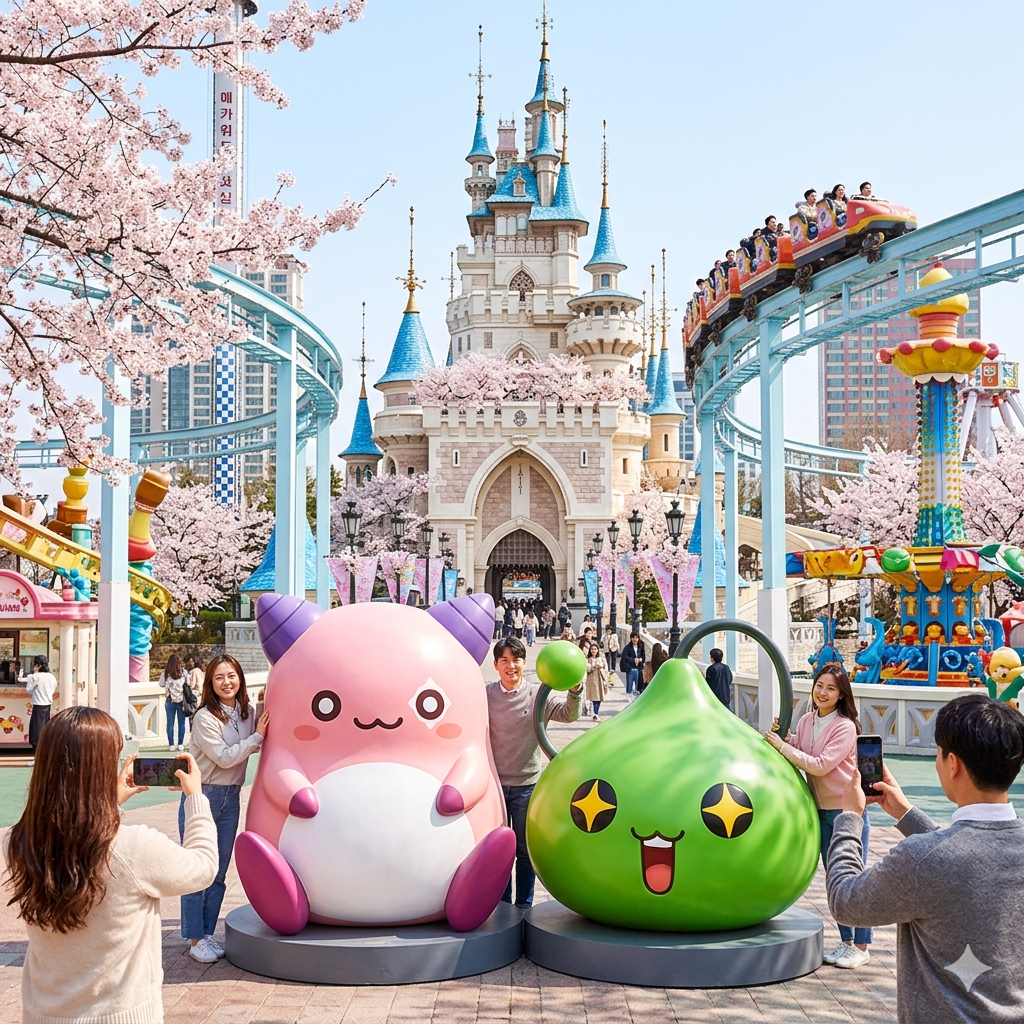
(This image was generated with AI and may differ from reality.)
Around the zone, Maple Store and Maple Sweets sell drinks and snacks inspired by in-game items. Visitors can try Red Potion and Blue Potion drinks, a Pink Bean sundae, and Stone Express keyrings, turning familiar game objects into things they can actually taste and take home. The larger “MapleStory in Lotte World” seasonal festival, which runs from March 14 to June 14, also spreads across the wider park around the themed zone. With parades, Magic Castle projection mapping, QR-code character customization experiences, and a retro game zone, the event is designed to make the entire day feel like time spent inside the MapleStory universe.
After the official opening, Lotte World Adventure reported that visitor numbers rose by around 20 percent compared with the previous week, while foreign visitors increased by more than 15 percent. Part of that boost likely comes from the cherry blossom season, but Maple Island clearly played a major role in drawing fans in. Lotte World has emphasized that the appeal stretches beyond people in their 20s and 30s, reaching parents in their 30s and 40s who once played the game themselves and now visit with their children. One tourist from Taiwan said the experience felt like meeting a childhood game again during a family trip, combining nostalgia with something new.
The move to extend game IP into physical space is becoming a bigger part of Korea’s content strategy. Maple Island is a strong example of how a world that once existed only online can be turned into a tourism asset through rides, performances, and themed merchandise. In that sense, it fits into a broader Korean pattern already visible in the way K-pop and webtoons have expanded through concerts, exhibitions, and immersive events. For Nexon and Lotte World, the collaboration is not just about preserving the value of a long-running game franchise but also about opening up new revenue streams and new forms of cultural reach.
The response from international fans has been lively as well. Once news of the opening spread, communities in North America and Southeast Asia began filling with travel questions and visit reviews, while short-form videos of people posing with MapleStory characters on YouTube and TikTok drew strong attention. Because the seasonal festival only runs until mid-June, many fans now see the experience as something they have to catch within a limited window. Travel products that bundle the themed zone into broader Seoul itineraries have also begun to appear. That online momentum is feeding back into offline demand, helping turn the site into a kind of gaming pilgrimage stop.
There are also a few points that can confuse foreign readers. The name Maple Island is the same as an early tutorial area in the game, but this themed zone is a permanent installation inside Lotte World’s Magic Island in Jamsil, Seoul, not the same island from the game itself. Magic Island, meanwhile, is the name of Lotte World Adventure’s outdoor section, and Maple Island is one themed area inside it. The seasonal collaboration festival runs only from March through June, but the Maple Island zone itself is expected to remain open afterward. Attendance growth figures have also been reported using different comparisons, including week-over-week and year-over-year numbers, so they are best understood as signs of a strong early trend rather than a single fixed metric.
This project may feel like a beginning rather than an endpoint. To mark MapleStory’s 23rd anniversary, Nexon is preparing a special late-April event that will take over Lotte World, suggesting that Maple Island will continue to anchor new fan experiences beyond the initial launch. Lotte World is also reviewing additional collaborations with other game and animation IP, and it has already announced a Godzilla-and-Kong-themed ride for later in the year. If Maple Island continues to perform well, it could become a model for more partnerships between content companies and large-scale attractions.
In the end, Maple Island is more than just a new ride area. It represents a point where digital worlds and physical places begin to overlap in a way that feels meaningful to fans. Longtime players can revisit their memories in a new format, while children encountering MapleStory for the first time get to walk through the game world with their families. Experiences like this show how Korea’s content industry is evolving beyond simple consumption into tourism and cultural participation. As more fictional worlds become places people can physically visit, Maple Island may end up being remembered as one of the projects that helped define that shift.
Sources
- Lotte World brings MapleStory to life with new themed zone
- Nexon opens 2,000-square-meter 'Maple Island' at Seoul's Lotte World
- Nexon opens 'Maple Island' permanent theme zone at Lotte World Adventure
- Nexon announced on the 3rd that it will hold a large-scale spring season festival 'MapleStory in Lotteworld' using 'MapleStory' IP
- [Weekend in Game] The Game World Comes to Life: Game Companies Take on Meaningful Challenges
- South Korean amusement park opens up a MapleStory-themed land
- Nexon to open MapleStory-themed Maple Island at Lotte World