Why Korea Is Obsessed With 'Bolkku': The Small Joy of Customizing a Pen
Bolkku, or pen decorating, turned mix-and-match pens into a Korean DIY craze, showing how small custom touches became a youth retail trend.
In Korea lately, ordinary ballpoint pens have been turning into tiny personal statements, each one customized with its own colors, beads, and charms. On the fifth floor of Dongdaemun Market, trays filled with pen bodies and decorative pieces now draw long lines on weekends, changing the atmosphere of the market itself. What may look at first like a cute craft trend has become something larger: a new form of everyday customization that especially appeals to younger Koreans.
“Bolkku” is short for “ballpoint pen decorating.” The idea is simple: choose a pen body, pick a few charms or beads, and assemble your own writing tool. The pen bodies sold at Dongdaemun are designed for easy customization. The top and bottom are fixed, while the center is left open so decorative parts can be slipped in one by one. Each charm and pen body usually costs only a few hundred won to around 1,000 won, so the total price often stays in the 3,000 to 5,000 won range. The whole process takes only a short time, which makes it easy even for casual passersby to join in.
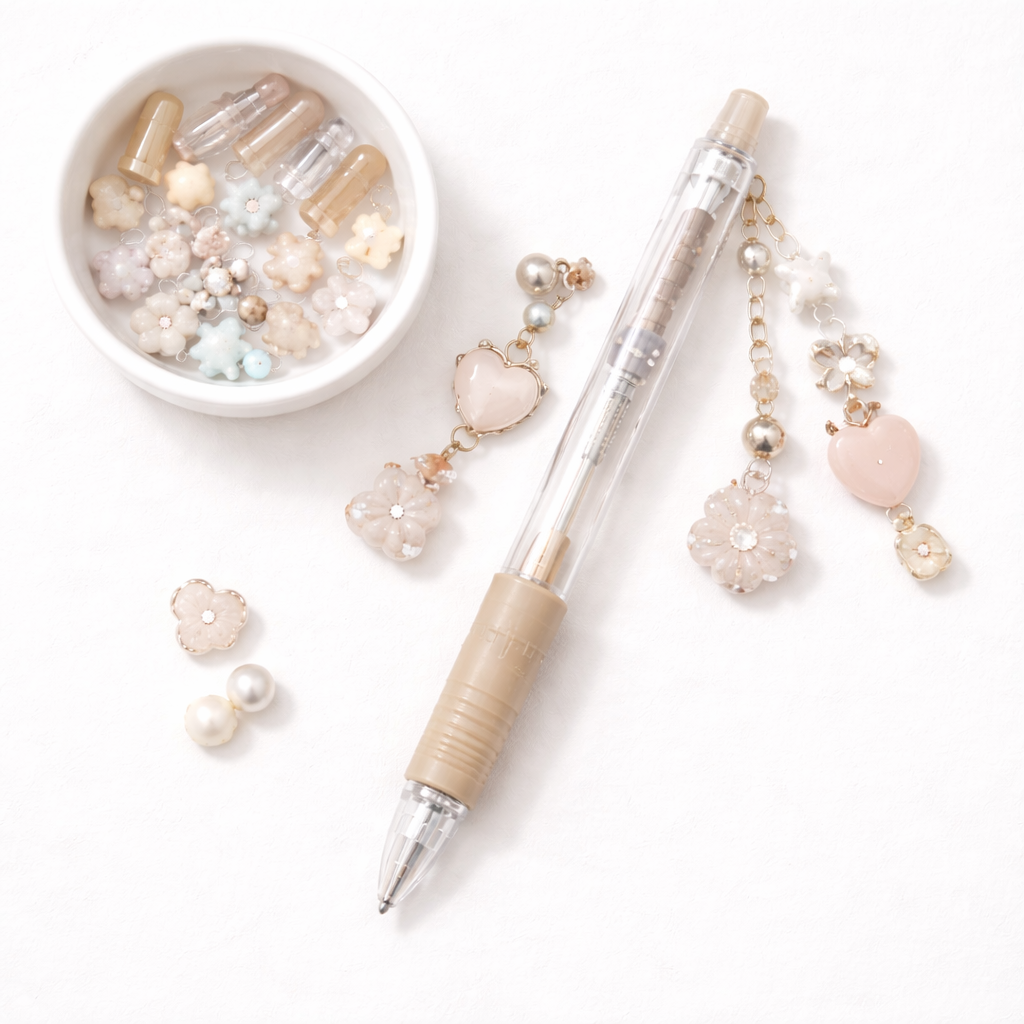
The trend did not appear out of nowhere. It grew out of Korea’s broader “decorating culture,” where people personalize everyday items as a way of expressing taste and mood. Diary decorating, known as “dakku,” and sneaker customization had already become familiar trends, and bolkku is the latest extension of that impulse. Korean newspapers reported that after the trend spread across social media late last year, Dongdaemun’s accessory-material market began filling with college students, office workers, parents, and children. Local media also noted that the trend had moved beyond Seoul into cities such as Suwon, where shops began setting up dedicated pen-decorating booths.
One reason bolkku has connected so strongly with younger consumers is that it sits at the intersection of affordability and individuality. With one pen and a few decorations, people can create something that feels personal without spending much money. That makes it easy for students and office workers, who may not have the time or budget for bigger hobbies, to take part without much hesitation. At the market, it often takes less than half an hour to choose the parts and finish assembling a pen, and the result is immediately shareable on social media. That structure of “little time spent, instant satisfaction gained” fits neatly with the emotional rhythms of busy young adults looking for small but tangible rewards in daily life.
Another notable feature is how widely the trend crosses generations and regions. At a stationery shop in Haenggung-dong, Suwon, for example, customers can choose from decorations priced between 300 and 1,000 won, along with pen bodies that cost about 1,000 won, and families often sit together making their own pens. Department stores and large shopping malls have also moved quickly to set up their own pop-up booths, offering pen bodies and decorations as sets or running hands-on programs with staff assistance. That reflects a broader consumer shift toward experiences in which people do not just buy an object, but also participate in making it.
For overseas readers, it helps to know that bolkku has little to do with luxury fountain-pen customization or specialist craftsmanship. The pens involved are ordinary mass-produced ballpoint pens made of plastic or metal, and assembly does not require tools or technical skill. Most decorations are lightweight items such as mini character figures, beads, or soft toy-like ornaments. That accessibility is exactly why the trend has drawn such a wide age range, from schoolchildren to parents.
Social media has been one of the biggest reasons the trend spread so quickly. Search hashtags like #볼꾸, #볼펜꾸미기, or #볼꾸챌린지 and you will find countless photos of finished pens and short review videos. People compare color combinations, fill baskets with parts from display trays, and trade tips on where to shop. Some popular creators’ videos have drawn hundreds of thousands of views, while maps pointing people to key locations in Dongdaemun and Suwon have circulated online. That kind of information-sharing keeps bringing more visitors offline, which in turn expands the size of the market.
Bolkku also shows how decorative consumption can serve a therapeutic purpose. Some people say the repetitive process of assembling the pen and watching it gradually take shape helps them relax. Others describe it as a perfect short break between classes or work. According to one Dongdaemun merchant, customer traffic increases especially after exam periods and on weekends, and keeping decorative parts in stock has become a constant task. Even though the craft itself is small, the satisfaction of holding a finished pen can be surprisingly strong, which is why many first-time visitors return later with friends or family.
In the end, the bolkku boom is about more than making cute pens. It reveals a lifestyle among younger Koreans that values affordability, individuality, and experience-based consumption. A low price point, quick and satisfying results, a cycle powered by online sharing and offline participation, and appeal across age groups have all helped turn pen decorating into a nationwide trend. From the outside, it may seem minor. But it offers a useful glimpse into how Korean consumers are finding ways to personalize everyday life and turn small objects into shared cultural experiences.